Cedar Valley News
Fictorial Number 427 · September 30, 2026
The Table Where Nothing Is Thrown Away
By Lars Olson
A man came into my store last week holding a lamp with a frayed cord, and before he said a word, I knew the question. Not can you fix it. Is it worth fixing? He had already priced a new lamp online, and the new lamp was cheaper than my afternoon. He wanted me to tell him to throw the old one out. I sold him a cord and a little of my own time instead, and he left looking like a man who had gotten away with something.
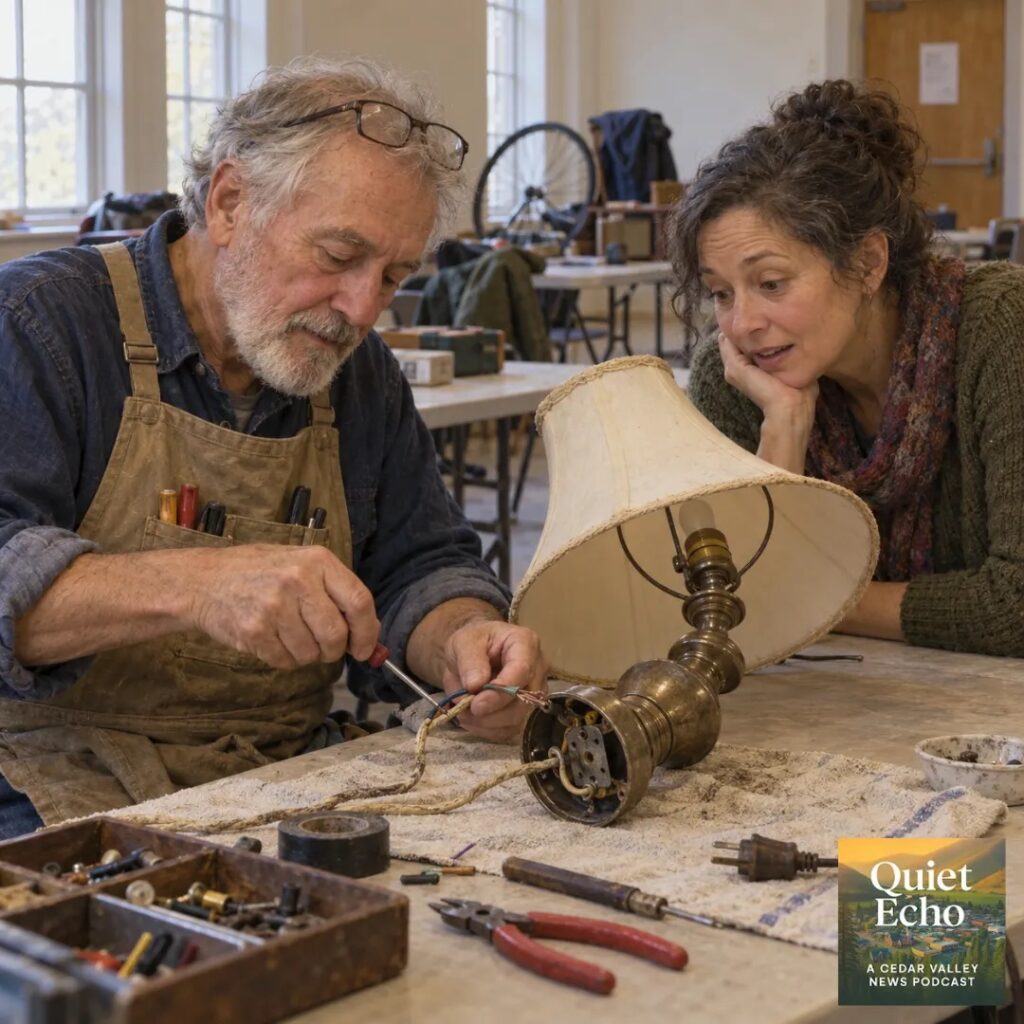
I thought of him when I read about a place in Burlington, Vermont, called the Old North End Repair Café. On the third Saturday of the month, in a room on North Street, neighbors bring their broken belongings and volunteers try to fix them. A bicycle wheel trued. A torn coat sewn back together. Whatever a person carries through the door. No charge. You sit at the table with the one mending your thing, and sometimes you learn to do it yourself.
The man who started it, Trav Fryer, gives the plainest reason there is. “Why would you throw it out?” he says. “It’s so much more efficient.” He does not talk like a crusader. He talks like a man who cannot stand waste, a language I speak fluently behind this counter.
One volunteer, Ali Hamedani, calls it a community where people support one another and visit. Anybody who has run a counter knows a hardware store was never only about the hardware. People come in for a washer and stay for the talk. A broken thing and a second pair of hands is an old way to sit beside each other and be useful.
One of the regulars, Chrissy Bedard, said the thing I have been trying to say for 40 years. Her mother grew up on a farm, and on a farm, she said, “the first move was always to try to mend it and keep it alive.” Mend it and keep it alive. On a farm you do not throw out the fence, the boot, the engine, the hard season, at the first sign of trouble. You mend it. You keep it alive. The mending is not about the fence. It is about who you become when mending is your first move instead of your last.
We have been trained, all of us, to throw things away. The new lamp is cheaper than the old cord, the new phone easier than the old battery. Somewhere along the line, discarding stopped being the last resort and became the first. A thing breaks, and before we have even looked at it, our hand is halfway to the curb.
Susan Alexander, who runs a reuse network up there, said the truest line of the piece. A dead toaster, she said, “may have 99% working parts and just one little thing that needs to be fixed on it.” Ninety-nine percent working, and thrown out anyway. Most people look at a broken thing and see the broken part. Behind a counter, you learn to see the rest, the ninety-nine still good, still working, waiting on the one repair and one person who knows how.
A table where a stranger will mend your bicycle wheel for nothing is a bigger thing than it looks. It is a small argument, made with a screwdriver, against the reflex of the curb. The lesson nobody at the table says aloud is not everything can be saved. Some things cannot, and a wise man knows the difference. But you owe the broken thing the question before you owe it the curb.
You have something you have been told to throw away. Maybe it only wants one part and an hour. Before you haul it out, ask the old farm question. Can it be mended? Sometimes the answer is no, and you let it go with a clear conscience. But most of us have quit asking at all, and the asking is the whole of it. A repair table is a humble thing to build: a few people, some broken belongings, a box of tools, the time to try. You have a kitchen table. You could start there.
Cedar Valley News is free, and it comes to your inbox every morning, six days a week. If this morning’s fictorial was worth your time, please forward it to someone who would value it. And if someone forwarded it to you and you’d like your own each morning, you can subscribe here.
Cedar Valley News has a Letters to the Editor page, and I would be glad to hear from you. What have you mended instead of replacing, and what are you still deciding whether to keep? Write and tell us. And if we have gotten a fact wrong, write and tell us, and we will run the correction.
This fictorial is part of the fictional Cedar Valley News series, written by Evan Swensen, Publisher, and Claude Marshall, AI Developmental Editor. While Lars Olson and the town of Cedar Valley are fictional, the Old North End Repair Café in Burlington, Vermont, and the people named here are real. As reported by VTDigger on September 26, 2026, Trav Fryer founded the repair café, which meets on the third Saturday of each month on North Street, where volunteers mend neighbors’ broken belongings, including bicycles and textiles, at no charge. Fryer, who took up the practice at repair cafés in Palo Alto, California, said, “Why would you throw it out? It’s so much more efficient.” Volunteer Chrissy Bedard, recalling her mother’s farm upbringing, said “the first move was always to try to mend it and keep it alive,” and volunteer Ali Hamedani described the café as a community of people supporting one another. Susan Alexander of ReuseVT said a dead toaster “may have 99% working parts and just one little thing that needs to be fixed on it.” It is a reflection, not a report. Source: VTDigger, September 26, 2026.