Cedar Valley News
Fictorial Number 428 · October 1, 2026
The Backyard Where a City Tells Its Stories
By Chloe Papadakis
I plan gatherings for a living, which means I spend my days on a question most people never think about: what makes a roomful of strangers decide to become something more than a roomful of strangers? It is harder than it sounds. You can book the band, hang the lights, set out the food, and still watch everyone leave as alone as they came. When I meet someone who has solved it, I pay attention. His name is Anthony Howell, and he solved it in his backyard.
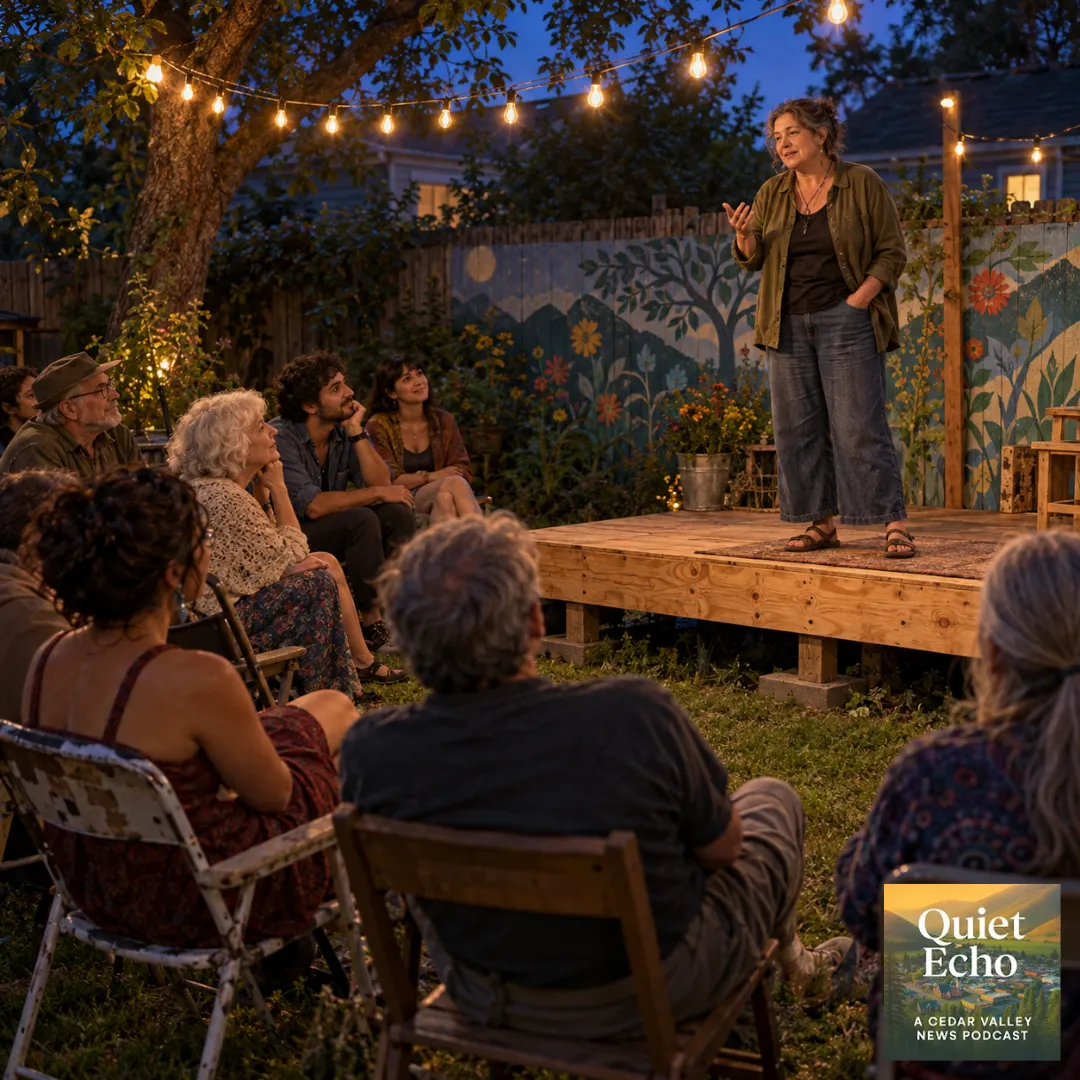
Howell works at a power plant in St. Louis. He is not an impresario. A few years ago he fell for a storytelling podcast, The Moth, where ordinary people stand up and tell true stories from their lives, and he went looking for something like it near home. He found nothing. So in November 2023 he built a little stage in his backyard on Tamm Avenue, put out chairs, and invited people to tell their stories. Twenty showed up the first night. He calls it the Tamm Story Slamm.
Look at how he built it, because the design is the whole miracle. It is free, always, on purpose. “I never want people to have to pay to come do it,” he says. “I don’t want anyone to feel left out.” There is no audition and no gate. “Everyone has a story on everything,” he insists, and he means it. Ten names go into a hat each night, and ten people take the stage. He has built the place up across the seasons: a real stage, a concession stand, murals on the fence, a lit sign he wired himself. The crowd runs from 18 to 93. And when the telling is done, there is a thing he calls Slamm Mail, where you write a letter or a drawing to another person in the room, a stranger, who writes you back.
Every piece of it is a decision, and every decision is right. Free means the room is not sorted by money. No audition means it is not sorted by talent. A hat means it is not sorted by who knows whom. He has quietly removed every filter we use to keep our rooms comfortable and small, and what is left is the actual town, 18 and 93 in the same folding chairs, listening to one another. I arrange events with real budgets and cannot always buy what he gets for free.
He does not call it an event. He calls it a church. “It brings people together and gives you this community family,” he told the magazine. “This is a way you can really get to know your friends and the other people in your community without any kind of pressure.” I have seen many events. The great ones all have this hidden quality. They are not performances you watch. They are rooms you are let into. The stage is almost a trick, a reason to gather. The real gathering is the listening.
We are told, constantly, we are connected. We carry the whole world in our pockets and have never been lonelier. And here is a man with a plywood stage and a hat full of names who has built, for nothing, the one thing the whole glowing apparatus cannot hand us. A place to stand in front of your neighbors, say something true, and be heard. Not a feed, not a comment thread. A person, on their feet, in a yard, with other people’s eyes actually on them. And then to sit and hear them back.
Here is what his backyard has me thinking. Somewhere in you is a room you wish existed. The reading, the supper, the circle of people who make the thing you make, the night your town would finally talk to itself. You have been waiting for someone to host it. Anthony Howell waited too, until he understood the host was going to be him. You do not need a budget or a stage or permission. You need a yard, a date, 10 chairs, and the nerve to tell people they are welcome. Everyone has a story. Somebody has to build the place where it gets told.
Cedar Valley News is free, and it comes to your inbox every morning, six days a week. If this morning’s fictorial was worth your time, please forward it to someone who would value it. And if someone forwarded it to you and you’d like your own each morning, you can subscribe here.
Cedar Valley News has a Letters to the Editor page, and I would be glad to hear from you. What gathering does your town need, the one you keep wishing someone would host? Write and tell us. And if we have gotten a fact wrong, write and tell us, and we will run the correction.
This fictorial is part of the fictional Cedar Valley News series, written by Evan Swensen, Publisher, and Claude Marshall, AI Developmental Editor. While Chloe Papadakis and the town of Cedar Valley are fictional, Anthony Howell and the Tamm Story Slamm in St. Louis, Missouri, are real. As reported by St. Louis Magazine on August 17, 2026, Howell, who works at a power plant, founded the free backyard storytelling gathering in November 2023, drawing 20 people its first night; it now runs six months a year with ten storytelling slots an evening and audiences ranging in age from 18 to 93, and features a pen-pal exchange he calls Slamm Mail. Inspired by the storytelling podcast The Moth, Howell said, “I never want people to have to pay to come do it,” and “I almost think of it as a church, where it brings people together and gives you this community family.” It is a reflection, not a report. Source: St. Louis Magazine, August 17, 2026.